
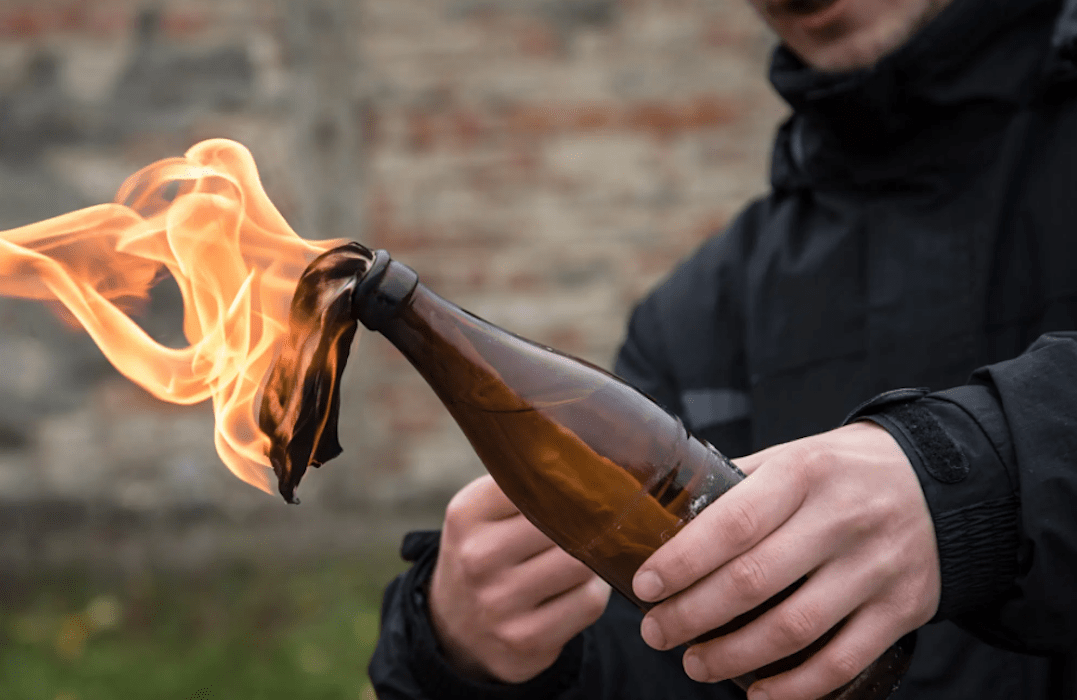
Criminal Law - Molotov cocktail - Elements of incendiary and explosive device - Manufacture and possession of explosives - 272 PC - Arson
The reversal of the almost established case law of our courts is inflicted by the Piraeus Maritime Court which by its judicial decision no. 16/2020 ruled that when the Molotov cocktail is thrown outdoors, it is not to be considered as and explosive but as an incendiary device. The main effect of this view is the inability to implement the provisions relating to weapons and explosives.
The Piraeus Maritime Court by its judicial decision no. 16/2020 attributed a different legal characterization to the Molotov cocktail thrown outdoors, considering it not as an explosive but as an incendiary device. The decision above overturns the up to date established case law of our courts which considered Molotov cocktail, when thrown outdoors, as an explosive device, as a result of which it applied then, in this case, the relevant provisions of l. 2168/2019 at least until the change brought by l.4619/2019 as amended by l. 4637/2019, where the acts of explosion, manufacture and possession of explosives, which are truly intertwined, encompass as criminal behavior, both the illegal carrying of weapons and the use of explosives (relevant articles 10 and 12 l. 2168/1993) as well as the use of weapons (14 l.2168/1993), concur apparently with the relevant provisions of PC and are covered thereby.
Notably, the said decision seems to accept the long-expressed view of the Lieutenant General – Deputy Chief of Police and lawyer Andrianos Gourbatsis in his studies in legal journals as well as in his monograph. Tellingly, in his more recent study (The criminal assessment of Molotov cocktail in the new Penal Code Crim.Pr. 11/2020 p. 1132 subs.) states that Molotov cocktail is a kind of improvised incendiary device and not an explosive device or bomb, which is an aggressive and lethal means due to the primary and instantaneous incendiary effects produced and only exceptionally and under certain specifications and conditions, that is, only indoors (enclosed spaces) can cause an explosion, so in these cases it has an ambiguous character, being at the same time an incendiary-explosive mechanism.
Thus, the Piraeus Maritime Court, judging following deliberation, ruled that an essential element for the objective nature of explosion is the provocation of an explosion which is a totally sudden phenomenon, where gases are released, which are under high extrusion pressure or are produced in a short time and whose expansion in multiple of their original volume causes a strong mechanical effect, accompanied by a crack, transient glow and release of heat or thrust. Besides, the above judicial judgment, accepts that the provision of article 1 par. 2 per. e’ of l. 2168/1993 remained unchanged after the amendment of the relevant paragraph by article 1 par.2 of l. 4678/2020 according to which, as “explosives” are considered solids or liquids which, for any cause whatsoever, undergo a chemical change and are converted into gaseous masses under conditions of high temperature and pressure, with explosive or explosive effects.
Following these considerations, the Council considered as erroneous the case law view that Molotov cocktail is an explosive device, regarding as direct result of its throwing the explosion and not the fire which is generated through the ignition and raising of the temperature, the violent rupture of the cylinder walls and release of gas. His arguments lie on the fact that by the use of Molotov cocktail mechanism, the rupture of the cylinder is caused due to this impact on the target (and not due to its temperature rise and the simultaneous violent release of gases), whilst the ignition of the materials occurs subsequently and after the rupture, without causing any chemical change producing a ballistic or explosive effect. Given that the main ingredient of Molotov cocktail is gasoline, which is a quite
flammable liquid, due to its high volatility, forming vapors above its free surface, which may ignite when there is flame, spark, etc., gaseous mixtures can only explode when they are in a certain range of concentrations (explosive limits) which for gasoline is 1.5-7.5%.
So, the judicial decision concludes that Molotov cocktail which is thrown in an outdoor environment may not cause an explosion, as the gaseous concentration (gasoline/ambient air vapors) is at all times less than the lower flammable mixture, that is, it is beneath 1,5% and therefore it is very poor, as fuel mixture, due to the presence of a large percentage of the ambient air oxygen and a proportionally low gasoline vapors percentage. Pursuant to these considerations, the judicial decision concluded that in the examined case, the throwing of a Molotov cocktail does not cause an explosion and, therefore, the objective nature of the punishable act of explosion under article 272 PC, based on which the public prosecutor recommended the referral of the defendant, is not met.
In fact, the decision concludes that the nature of the Molotov cocktail as a weapon is not appropriate for causing harm to people outdoors but as a very small explosive, is effective when thrown on vehicles or buildings where fire can be transmitted and spread. He goes on to say that, Molotov cocktail can prove lethal weapon when there are people trapped inside the target- vehicles or buildings; however, even in such a case, damages are by the fire caused and not by Molotov cocktail itself.
Based on these considerations and given that in the under investigation case, as adjudged, the Molotov thrown by the defendant, objectively could not cause a serious bodily injury to anyone, because on the one hand the only persons within range were the Riot Police men, who wore riot gear, which means that they were adequately protected against Molotov cocktails whilst, this device, when thrown at night is visible as it ignites and does not have a high firing speed as it is thrown by hand, therefore, there is time to avoid it. Even if for any reason it could not be avoided, there was no possibility of the fire spreading in the police uniform because, as in the under -judgment case, an armored water jet was operating next to them, and moreover, all Riot Police squads dispose of a portable fire extinguisher. Therefore, it was considered that the defendant did not seek to inflict serious bodily injury to any police officer, by throwing Molotov cocktails, as, in a different case he would have used other means that would have served this purpose more efficiently, such as flares in a straight shot or stones or heavy marbles from great heights, such as apartment buildings’ roofs, but only to cause disturbance or/and to repel of the police forces that attempted to remove them from the area of Exarcheia or/and to arrest them.
However, in the reasoning of the decision above, it is pointed out that the throwing of a Molotov is not completely harmless even when the target is Riot Police men on foot, given that by throwing them he accepted the possibility to slightly injure one of them, either from the breaking of the bottle or froma small fire that could have been transmitted to his uniform, something that the specific weapon could actually have caused. Therefore, it referred the defendant for an attempted simple bodily injury, amongst other things.
Equally interesting, however, is another consideration of the decision above, which although had originally attributed liability to the defendant for arson in concert, the judicial decision, given that none of the witnesses testified specifically that it was the defendant that had caused these fires, in combination with the view that “The Police position that any detainee should be accused for the joint perpetration of all acts committed by the crowd in which he participated, is attributing collective liability which is rejected by the law” had finally dismissed the case even for the offense of arson. Of course, the fact that the objective nature of the punishable act was not met had also plaid a role, as the key element of arson is the causing of fire in any manner whatsoever, that is, the explosion of a significant and of unusual extent fire, which tends to spread and cannot be easily extinguished, which exists, when, after the departure of the perpetrator and the consumption of the incendiary substance, material or device, the fire continues on its own, something that does not seem to be met in the present case.
Share this post
Recent Posts

Right to Silence – Grounds for an administrative offense…
Right to Silence – Grounds for an administrative offense – Administrative sanction of criminal nature – Criminal Liability – Privileged information – Market manipulation –

Torture – Criminal Law – Abuse by an individual – Inhuman behavior…
Torture – Criminal Law – Abuse by an individual – Inhuman behavior – Article 3 of the European Convention on Human Rights (ECHR) – Fair

Criminal Law – Statute of Limitation for tax evasion – Retroactive application of a newer law…
Criminal Law – Statute of Limitation for tax evasion – Retroactive application of a newer law – Article 2 PC – opposition of a criminal